
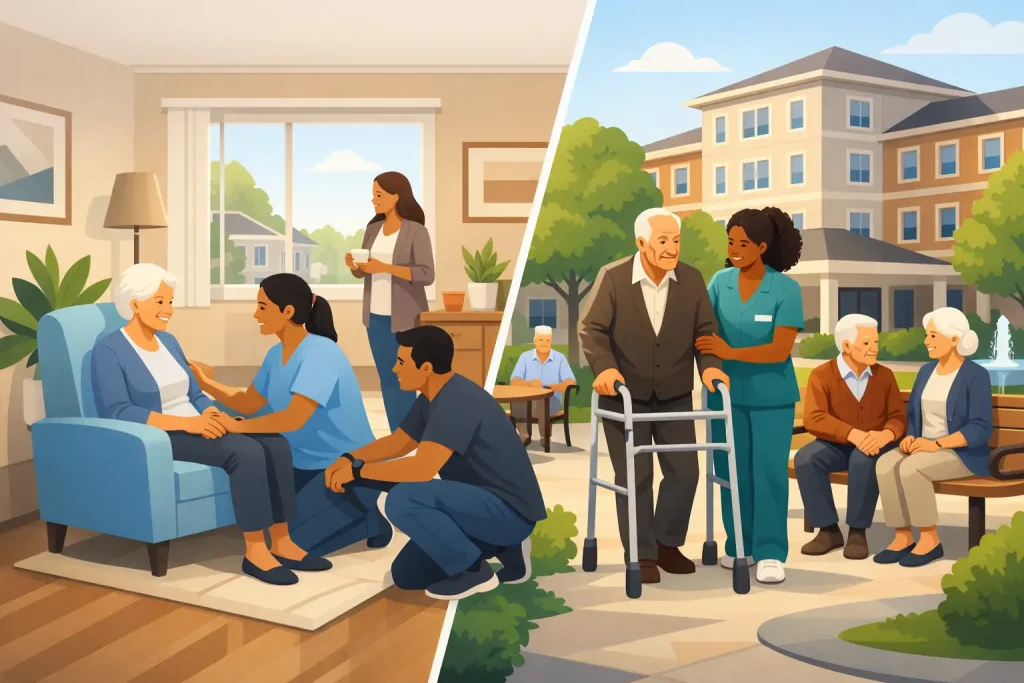
A parent starts needing help with bathing, meals, or getting safely from room to room, and suddenly the question feels very personal. When families compare home care vs assisted living, they are rarely choosing between two simple services. They are trying to protect safety, preserve dignity, and make a decision they can live with.
The right choice depends on health needs, daily routines, budget, social preferences, and how much support family members can realistically provide. For some people, staying at home with the right help brings comfort and stability. For others, assisted living offers structure and peace of mind that a home setting can no longer provide.
Home care vs assisted living: what is the difference?
Home care means support is brought into the person’s own home. A caregiver may help with bathing, dressing, grooming, toileting, mobility, meal preparation, medication reminders, light housekeeping, companionship, errands, and safety supervision. The goal is to help the person remain in familiar surroundings while receiving the assistance they need.
Assisted living is a residential setting designed for older adults who need help with daily activities but do not require the level of care provided in a nursing home. Residents usually have a private or semi-private apartment or room, along with access to meals, staff support, activities, housekeeping, and a more structured environment.
On paper, the difference looks straightforward. In real life, it often comes down to one key question: can this person live safely and well at home with the right support, or would a residential setting better meet their needs?
When home care is often the better fit
Home care is often a strong option for people who want to remain in familiar surroundings and whose needs can be met safely at home. That includes seniors who need help with personal care, people recovering after surgery, medically fragile clients who need close attention to routines, and adults with disabilities who benefit from one-on-one support.
There is a comfort in waking up in your own bed, using your own bathroom, seeing familiar photos on the wall, and keeping long-established habits. For many people, that comfort is not a small detail. It can reduce confusion, ease stress, and support emotional wellbeing.
Home care can also be more flexible than families expect. Some people need only a few hours of help each week. Others need daily support, overnight supervision, or respite services that give family caregivers time to rest. Care can often be adjusted as needs change, which makes it helpful for situations that are still evolving.
This option can be especially meaningful when independence matters deeply to the client. Instead of adapting to a facility schedule, the care plan can adapt to the person’s routines. Meals, bathing times, outings, and social activities can remain more personal and familiar.
That said, home care works best when the environment is reasonably safe and the support available matches the person’s actual needs. If someone is frequently wandering, falling often, or needing constant monitoring, the home setup may become harder to manage.
When assisted living may make more sense
Assisted living may be the better choice when daily needs have become too great for a home setting to handle consistently. If a person needs regular supervision throughout the day, struggles with isolation, forgets meals and medications, or is no longer safe alone for long periods, a residential community may offer more reliable coverage.
For some families, the issue is not willingness. It is capacity. An adult child may be coordinating appointments, checking in every day, managing medications, shopping, and trying to work full time. Over time, even loving families can become stretched beyond what is sustainable.
Assisted living can reduce that strain by offering built-in support. Meals are prepared, staff are available, and social activities are part of the setting. That structure can be reassuring for individuals who thrive with routine or who are becoming more vulnerable living alone.
It can also help with loneliness. This is one of the most overlooked parts of the decision. A person may be technically safe at home for part of the day but still feel isolated, especially after losing a spouse, stopping driving, or having fewer visitors. In assisted living, there is more regular contact with staff and other residents.
Still, moving out of the home is a major change. Some people adjust well. Others experience grief, resistance, or disorientation. The emotional side of the move matters just as much as the practical side.
Cost matters, but the comparison is not always simple
Families often assume one option is clearly cheaper than the other. In reality, cost depends on how much care is needed and what is included.
Home care is usually billed based on hours of service. If someone needs a few hours a day or only part-time support, home care may be the more cost-effective choice. It can also prevent unnecessary moves during recovery periods or while families assess long-term needs.
But if a person needs many hours of care every day, especially around-the-clock supervision, costs can rise quickly. In those situations, assisted living may provide a more predictable monthly expense.
At the same time, assisted living comes with its own financial considerations. Base rates may not include every level of support, and added care needs can increase the monthly bill. There may also be entrance fees, medication management charges, or other service costs depending on the community.
This is why families should look beyond the headline number. The better question is: what level of support does this person need today, and what will they likely need six months from now?
Safety, health needs, and the “it depends” factor
The most honest answer in the home care vs assisted living conversation is that it depends. A person may do very well at home with caregiver support, family involvement, and a few home modifications. Another person with the same diagnosis may need the consistency of assisted living because of memory issues, behavior changes, or frequent nighttime needs.
Mobility is a good example. Someone who needs help transferring from bed to chair may remain safe at home if the caregiver schedule is reliable and the home layout supports movement. But if there are stairs, narrow bathrooms, or long periods without supervision, risk increases.
Cognitive changes matter too. Mild forgetfulness does not always require a move. But if confusion is leading to missed medications, wandering, leaving the stove on, or unsafe decisions, families should take those signs seriously.
Medical complexity is another factor. Home care can support many non-medical daily needs very well, but it is not the same as a clinical setting. The more complex the condition, the more important it becomes to assess whether home support is enough.
Questions families should ask before deciding
Before choosing either option, it helps to slow down and look at daily life as it really is, not as everyone hopes it is. How often is help needed with bathing, dressing, toileting, walking, meals, and reminders? Is the person safe when alone? Are family caregivers already overwhelmed? Is isolation becoming part of the problem?
It also helps to ask the older adult or client what matters most to them. Some people value staying home above all else. Others care more about having company, built-in meals, and less household responsibility. A good decision should reflect not only care needs but also the person’s preferences, habits, and sense of dignity.
If the situation is changing quickly, families do not always need to make a permanent choice right away. Home care can sometimes serve as a starting point after a hospital discharge, during recovery, or while the family gathers more information. In other cases, a short trial in assisted living may reveal that the structure is helpful and welcome.
There is no one right answer for every family
Choosing between home care and assisted living is not about doing what sounds best on paper. It is about matching care to the person in front of you. The safest option is not always the most comforting one, and the most familiar option is not always the one that can meet long-term needs.
What families usually need most is clarity. They need an honest view of what support is required, what the home environment can safely handle, and how much responsibility relatives can continue carrying without burning out. When those pieces are looked at carefully, the right direction often becomes clearer.
At Comfort Zone Home Healthcare, families across New Jersey often come to this decision carrying equal parts love and worry. If that sounds familiar, give yourself permission to choose the path that offers the most dignity, stability, and peace of mind for everyone involved. Sometimes the best next step is not the forever solution. It is simply the one that helps your loved one feel safe, supported, and cared for right now.