
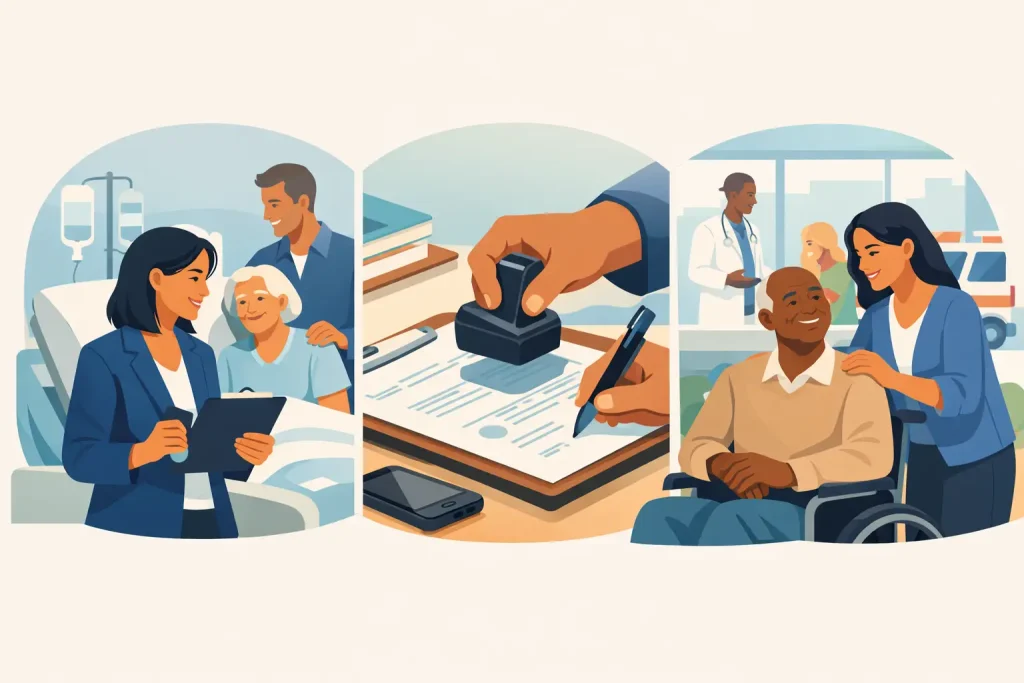
A hospital room is rarely where anyone expects to handle legal paperwork. Yet families are often asked to make decisions quickly, gather signatures, and finalize documents while a loved one is recovering, under stress, or preparing for discharge. In those moments, a mobile notary for hospital documents can bring needed support directly to the bedside, helping the process feel more manageable and respectful.
When someone is hospitalized, the need for notarization usually comes at a difficult time. A patient may be facing surgery, a change in long-term care plans, or new questions about who can make decisions on their behalf. Adult children may be coordinating from work, caregivers may be balancing several responsibilities, and hospital staff may be trying to help without being able to act as a notary themselves. Convenience matters, but so do patience, timing, and a clear understanding of what the signer is able to do.
When a mobile notary for hospital documents is needed
Hospital-related notarizations often involve documents that support medical, financial, or personal decision-making. Common examples include powers of attorney, advance directives, affidavits, consent forms, guardianship-related paperwork, and other forms tied to care planning or personal affairs. In some cases, the document is needed before discharge. In others, it is part of a broader family effort to organize important matters while the patient is available to sign.
Not every hospital document requires notarization, and that distinction matters. Some healthcare forms need witnesses rather than a notary. Others may need both, depending on the document type and state rules. That is why families should avoid assumptions, even when a form seems straightforward. Taking a moment to confirm the requirements with the issuing attorney, healthcare provider, or agency can prevent delays and repeat visits.
This is also where bedside service can make a real difference. Transporting a patient to an office is often unrealistic, especially after surgery, during rehabilitation, or when mobility is limited. A mobile notary meets the signer where they are, which reduces strain and helps families address urgent paperwork without adding another difficult trip.
What a hospital bedside notarization involves
The notary’s role is specific. A notary verifies identity, confirms willingness to sign, and checks that the signer appears aware of what they are signing. The notary does not give legal advice, choose the document, or explain its legal effect in place of an attorney. This boundary protects everyone involved.
In a hospital setting, those responsibilities require extra care. The notary must be confident that the signer is alert, communicating clearly, and signing voluntarily. If the patient is heavily medicated, confused, asleep, or unable to respond in a way that shows understanding, the notarization may need to be postponed. That can be disappointing for families, especially when time feels short, but it is an important safeguard.
A thoughtful mobile notary will usually ask a few practical questions before the visit. Is the patient awake and oriented? Do they have valid identification available? Is the document complete, with no blank spaces that should be filled in later? Will witnesses be needed? These details help the appointment go more smoothly and reduce the chance of arriving only to learn that a required step is missing.
Hospitals themselves may also have visitor procedures, front desk check-in requirements, or limits on how many people can be in the room. In some cases, a nurse may need to confirm whether it is a good time to enter. A bedside notarization is often brief, but it still works best when handled with sensitivity to the care environment.
Capacity, consent, and timing
One of the most misunderstood parts of hospital notarization is the question of mental capacity. Families sometimes assume that if a document is urgently needed, the notary can simply witness the signature and stamp it. It does not work that way. The signer must be able to understand what they are signing and act of their own free will.
That does not mean a hospitalized person cannot sign. Many patients are fully capable of signing documents during a hospital stay. But capacity can vary based on pain, medication, fatigue, diagnosis, or the timing of treatment. A patient may be clear and communicative in the morning and too drowsy later in the day. It depends on the person and the circumstances.
For that reason, timing matters. If the patient has just received strong medication or returned from a procedure, it may be wise to wait. Families can often reduce stress by planning the appointment during a calmer period, when the signer is rested and able to speak clearly. That small adjustment can make the difference between a successful notarization and a postponed one.
Consent is just as important. The signer must want to sign. If anyone in the room appears to be pressuring the patient, the notary may stop the process. This can feel frustrating if relatives disagree or if emotions are running high, but protecting the signer is part of the notary’s duty.
How families can prepare for a mobile notary visit
A little preparation helps bedside notarization move forward with less confusion. The first step is making sure the document is the correct one and that all non-signature sections are completed in advance. A notary can notarize a signature, but should not be the person deciding what goes in the form.
Identification is another common issue. In most cases, the signer will need an acceptable, current ID. If the patient does not have it at the hospital, families may need to retrieve it before the appointment. Trying to solve that problem after the notary arrives can create avoidable delays.
It also helps to verify whether witnesses are required. Some documents call for one or two witnesses in addition to notarization. A notary may or may not be able to provide witnesses, so this should be discussed ahead of time. Hospitals do not always supply staff members to serve in that role.
Communication matters too. Letting the notary know the room number, unit, parking instructions, and any access rules can save time. If the patient’s condition changes before the appointment, a quick update is helpful. Families often feel pressure to keep moving, but being honest about whether the signer is alert enough is the better choice.
Why bedside notarization can ease discharge and care planning
Hospital stays often lead to larger care decisions. A patient may be moving to rehab, returning home with support, or adjusting to a new level of assistance. During that transition, paperwork can quickly pile up. A mobile notary does not solve every part of discharge planning, but it can remove one practical barrier at a time when families already have a great deal to manage.
That is especially true when relatives live out of town, caregivers are stretched thin, or the patient has limited mobility. Having a professional come to the hospital can reduce scrambling and help important documents get handled in a timely way. It also allows the patient to remain in a familiar care setting instead of being moved simply to complete a form.
For families in New Jersey, this kind of support can be particularly helpful when care coordination is happening across hospitals, rehab facilities, and the home. A provider such as Comfort Zone Home Healthcare understands that paperwork is not separate from care. It is often part of how families protect a loved one’s wishes, prepare for recovery, and put the right support in place.
What to expect from a respectful notary experience
The best hospital notarizations are not rushed, even when they are urgent. They are calm, clear, and handled with dignity. A good mobile notary understands that the room may include worried relatives, a tired patient, and interruptions from clinical staff. Professionalism matters, but so does compassion.
Families should expect the notary to verify identity, review the notarial portion of the document, and speak directly to the signer. That direct communication is important. Even if a spouse, child, or guardian arranged the appointment, the notary must still confirm the signer’s awareness and willingness whenever the signer is the person executing the document.
They should also expect honesty. If the notarization cannot proceed because the patient lacks ID, needs witnesses, or does not appear aware enough to sign, a responsible notary will say so. While that may be hard to hear in the moment, it is far better than completing a notarization that may later be challenged or rejected.
When families are facing medical uncertainty, small practical supports can make a meaningful difference. A mobile notary for hospital documents brings one of those supports directly to the bedside, helping people handle important paperwork with less strain and more peace of mind.