
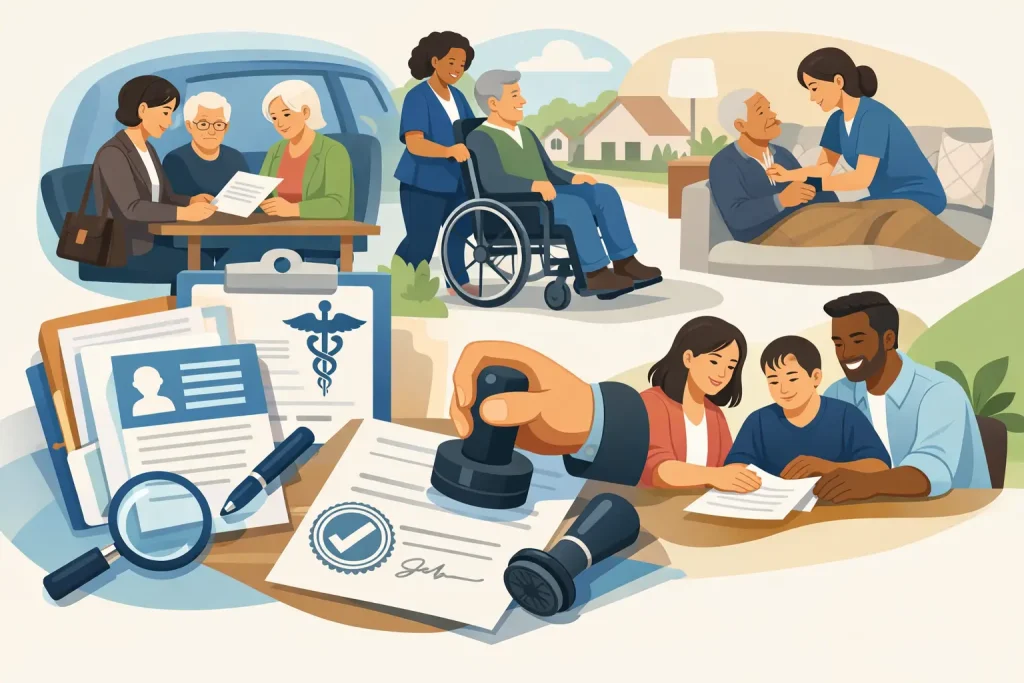
A hospital discharge packet, a sudden change in a loved one’s health, or a move into home care can bring urgent paperwork at the exact moment a family has the least time to sort through it. Understanding the 8 documents needing medical notarization can help families prepare calmly, protect a loved one’s wishes, and avoid preventable delays.
Medical notarization is not a separate type of legal authority in New Jersey. It simply refers to notarizing documents connected to healthcare, care decisions, disability services, benefits, or end-of-life planning. A notary verifies the signer’s identity, confirms that the person appears willing to sign, and completes the required notarial certificate. A notary does not give legal advice, determine mental capacity, explain a document’s legal effect, or decide whether a document is appropriate for a family’s circumstances.
When Healthcare Paperwork Needs a Notary
Not every health-related document requires notarization. Some require witnesses instead, while others may be accepted without either. Requirements can also differ by state, healthcare system, insurance carrier, court, or financial institution.
That distinction matters. A form can be properly notarized and still be rejected if it has the wrong version, is missing a required witness, or was not signed by the necessary healthcare professional. Before scheduling a mobile notary, families should review the form instructions or ask the organization receiving it what they require.
8 Documents That May Need Medical Notarization
1. Advance Directives
An advance directive allows a person to express healthcare wishes if they cannot speak for themselves. In New Jersey, this may include appointing a healthcare representative and documenting preferences about life-sustaining treatment, comfort care, and other medical decisions.
New Jersey advance directives can generally be signed before two adult witnesses or acknowledged before a notary public, attorney, or another person authorized to administer oaths. Families should use the execution method stated on the form and make sure the chosen witnesses meet any restrictions listed there. The person signing should be alert, willing, and able to communicate their decision at the appointment.
2. Durable Financial Power of Attorney
A durable financial power of attorney gives a trusted agent authority to handle financial matters if the principal becomes unable to manage them. It can be especially useful when a client is hospitalized, recovering after surgery, or receiving long-term care and needs help with bills, insurance matters, or banking.
Although this is a financial document rather than a medical one, it often becomes urgent during a healthcare crisis. In New Jersey, powers of attorney generally require notarization. Because banks and other institutions may have their own review procedures, it is wise to complete this document well before it is needed.
3. Healthcare Proxy Forms From Another State or Facility
A healthcare proxy appoints someone to make medical decisions for a patient when the patient cannot do so. In New Jersey, this authority is often included within an advance directive. However, a hospital, residential program, or prior state of residence may use a separate healthcare proxy form.
Some versions require witnesses, some offer notarization as an alternative, and others may request both. If a loved one has recently moved to New Jersey or is receiving care across state lines, have the receiving provider review the document rather than assuming an older form will be accepted.
4. HIPAA Authorizations
A HIPAA authorization permits healthcare providers to share protected health information with a named family member, caregiver, attorney, or other trusted person. Without appropriate authorization, even a close relative may have difficulty obtaining updates or records for an adult patient.
A standard HIPAA authorization does not always require notarization. Still, certain providers, legal matters, or special authorization forms may request a notarized signature to reduce questions about identity and consent. Read the form carefully, particularly when it involves extensive records, behavioral health information, or communication with a third party.
5. Medical Consent Authorizations
Medical consent forms may authorize another adult to seek care or make limited treatment decisions for a child, dependent adult, or person receiving support services. These documents can be helpful when a parent, guardian, or primary caregiver will be away and another trusted person may need to act quickly.
Notarization is not universally required, but schools, camps, travel programs, residential settings, and healthcare providers may request it. The scope should be clear: identify who may consent, what situations are covered, and how long the authorization remains effective. A broad form may be convenient, but it should never give more authority than the signer intends.
6. Guardianship Filings and Sworn Statements
When an adult can no longer make or communicate safe decisions and no valid decision-maker is in place, families may need to pursue guardianship through the court. Guardianship cases commonly involve verified pleadings, certifications, affidavits, medical evaluations, and other court-directed documents.
Not every page in a guardianship matter needs notarization, and some documents may instead require a signed certification under New Jersey court rules. The court, attorney, or legal aid provider can clarify what is needed. A mobile notary can assist with documents that specifically require an acknowledgment or oath, but cannot advise whether guardianship is necessary.
7. Insurance, Disability, and Benefit Affidavits
A serious illness or disability can create paperwork for private insurance, long-term care coverage, life insurance, disability benefits, or public assistance programs. Some carriers request a notarized affidavit, statement of claimant, assignment, or authorization before releasing information or processing a claim.
These forms can be time-sensitive, particularly when a family is arranging home care, respite support, or a safe discharge plan. Check whether the insurer requires an original notarized form, a particular notarial wording, or supporting medical documentation. Completing the wrong version can delay benefits when support is needed most.
8. Wills, Trust Documents, and Self-Proving Affidavits
Estate planning is not medical paperwork, but it often comes up when someone is facing a serious diagnosis, planning for long-term care, or putting end-of-life decisions in order. A will itself is typically signed with witnesses. A self-proving affidavit attached to the will may be notarized so the witnesses may not need to appear in court later.
Trust documents and related estate planning forms may also need notarization. Because the rules can be technical and documents have lasting consequences, these should be prepared or reviewed by a qualified attorney. A notary’s role is limited to the notarization process, not drafting or interpreting the plan.
Documents That Are Often Confused With Notarized Forms
A Do Not Resuscitate order or Practitioner Orders for Life-Sustaining Treatment form is generally a medical order completed with a healthcare professional. It is not simply a form a family can notarize to make it valid. Likewise, a doctor’s letter, medication list, discharge instructions, and many routine medical releases usually do not need notarization unless the receiving organization specifically requests it.
This is why asking one direct question before the appointment is so useful: Does this document need a notary, witnesses, an oath, a healthcare provider’s signature, or some combination of these?
Preparing for a Mobile Notary Visit
A smooth appointment starts with preparation. The signer should have an unexpired government-issued photo ID, the complete document without blank signature pages, and any witnesses required by the form. The signer must be present and must sign willingly. If the signer cannot physically sign, ask in advance about lawful alternatives, since procedures depend on the document and situation.
It also helps to choose a quiet setting where the signer can focus without pressure. If the appointment is at a hospital, rehabilitation center, nursing facility, or private residence, allow time for check-in procedures and the signer’s care schedule. Families should avoid asking a notary to backdate a document or notarize a signature that was not personally acknowledged in the notary’s presence.
For New Jersey families managing health changes, care transitions, or disability-related planning, a prepared document can provide reassurance when decisions need to be made quickly. Comfort Zone Home Healthcare offers mobile notary services with the same respectful, client-centered approach families expect during sensitive moments.
A completed form cannot remove every hard decision, but having the right people informed, the right documents ready, and the proper signatures in place can give a loved one’s voice the care and attention it deserves.